Dead Sea Scales™: The 5 Missing Notes
Extended Modal System
 Meet the Creator — Christopher Dean
Learn hundreds of scales with just 7 shapes
How to Use the Interactive Fretboard
① Select a Key and Mode from the dropdowns below
② Hit ▶ Play Scale to hear the notes ascending
③ Adjust BPM and Direction to change playback
④ Switch between Multi-string and Single-string views
⑤ The Clock shows which notes are in the current scale
⑥ Empty positions on the clock are the 5 Missing Notes™
⑦ Explore 77 exotic modes in the extended families below
Extended Modes (Missing Notes Showcase)
Else World Scales — opposite operation, same chromatic note
🎸 Guitar Fretboard (Standard Tuning)
Key: F
Mode: Ionian (Major)
The 7 Diatonic Modes
Now let's get into Relative Modes
(The remainder of this section will deal with the relative modes in the key of F Major)
Let's dispel some mysticism. A "relative mode" is just a different pattern of the same grouping of notes. In this example, the seven patterns of the Major scale are all accessible by taking the first note of any pattern and moving it to the end, unlocking the next pattern (See below, this image helped me the most to understand how the modes "relate" to each other).
Single Octave Patterns
Dispelling the Mysticism
A "relative mode" is simply a different pattern using the same grouping of notes. In our F Major example, all seven mode patterns are accessible by taking the first note of any pattern and moving it to the end—this unlocks the next pattern. The cascading diagram below shows exactly how the modes "relate" to each other.
Understanding this connection is the key to mastering all seven modes.
1️⃣ Major Scale (Ionian Mode)
Shown above in the key of F Major (Ionian shape). Play this over and over until you are familiar with the shape with little to no mental effort.
The Major scale typically has a happy sound due to the 3rd note being two whole-tones away from the root. You know this as Solfège: Do-Re-Mi-Fa-Sol-La-Ti-Do.
Pattern: W W H W W W H — Note the location of the 3rd, 6th, and 7th scale degrees.
2️⃣ Minor Scale (Aeolian Mode)
Shown above in the key of D Minor (Aeolian shape). Play this over and over until you are familiar with the shape with little to no mental effort.
The Minor scale typically has a sad sound due to the 3rd note being a whole tone and a half-step away from the root. This inserts a half-step interval, creating tension.
Pattern: W H W W H W W — Note the location of the now flattened 3rd, 6th, and 7th scale degrees.
The Cascading Pattern: How Modes Relate
← swipe to scroll →
All 7 Modes in F Major - 2 Octaves
How to Practice These Patterns
1. Take it one mode at a time. Don't overwhelm yourself. Review each pattern individually and get comfortable with it before moving to the next.
2. Always start and end on the RED note. That is the root note of the mode and will preserve the overall feeling and character of the mode.
3. Notice the connection between modes. As each pattern travels past the second octave (ending on the highest RED note on the B string), the continuation of the pattern on the high e string shows the first three notes of the next mode. For example, with F Ionian starting on the low E string, you can see the G Dorian pattern beginning on the high e string. This is the glue that ties the modes together—the last three notes in one pattern are the first three notes in the next.
4. Challenge yourself to stitch patterns together. Once you're comfortable, try starting the Ionian pattern at the octave (around the 13th fret area) and see if you can connect it to the rest of the patterns moving up the next octave. This will help you see the modes as one continuous system across the entire fretboard.
Mnemonic to remember the order: "I Don't Pick Lyrics My Aunt Loves"
Ionian (Major Scale)
Vibe: Happy, bright, uplifting
Example: Star Wars - A New Hope theme
Key Feature: Major 3rd (two whole steps from root)
Dorian
Vibe: Minor with a brighter edge
Example: Avengers theme
Key Feature: Natural 6th (compared to Aeolian)
Phrygian (Spanish Minor)
Vibe: Dark, exotic, Spanish flavor
Example: Metallica - "Wherever I May Roam"
Key Feature: Flat 2nd creates immediate tension
Lydian
Vibe: Dreamy, floating, ethereal
Example: The Simpsons theme
Key Feature: Raised 4th creates tension and brightness
Mixolydian
Vibe: Bluesy, funky, rock
Example: "Sweet Home Alabama"
Key Feature: Flat 7th creates bluesy flavor
Aeolian (Natural Minor)
Vibe: Sad, melancholic, emotional
Example: "Stairway to Heaven" verse
Key Feature: Minor 3rd, flat 6th and 7th
Locrian
Vibe: Unstable, tense, unresolved
Example: Metal riffs, horror soundtracks
Key Feature: Diminished 5th (tritone) - the "devil's interval"
Parallel Modes (Modal Neighbors)
Know what mode is a string above or below where you're playing:
- Ionian → Lydian (4th degree)
- Dorian → Mixolydian
- Phrygian → Aeolian
- Lydian → Locrian
- Mixolydian → Ionian
- Aeolian → Dorian
- Locrian → Phrygian
Diatonic · Hexatonic · Pentatonic Decoder
All 7 modal roots shown in their full 7-note (diatonic), 6-note (hexatonic), and 5-note (pentatonic) forms side by side — see exactly which notes drop out as you simplify.
Hexatonic / Pentatonic Decoder
All 7 modal roots shown in 7-note, 6-note, and 5-note forms side by side — see exactly which notes to drop as you simplify.
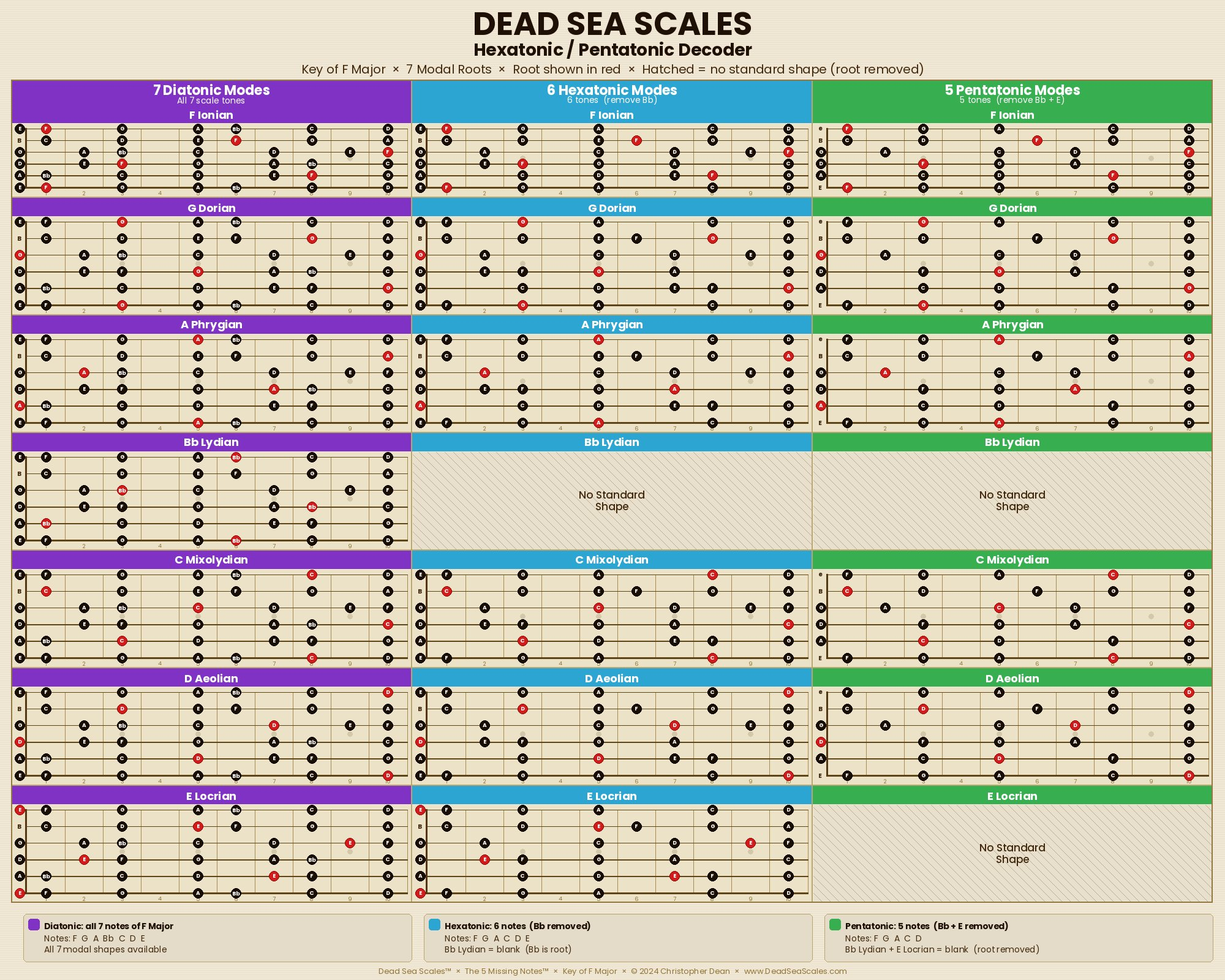
← swipe to explore · root shown in red · hatched = no standard shape (root removed) →
Where Do I Start?
Your roadmap to mastering the fretboard — one step at a time.
Learn Your Intervals
Everything in music is built from intervals — the distance between two notes. Before you can understand scales, chords, or modes, you need to hear and recognize these distances. There are only 12 possible intervals in Western music, and each one has a distinct sound and feeling.
Start here. Use the interactive fretboard on the Play tab to hear each interval. The Intervals tab shows you every interval mapped on the guitar neck with reference songs you already know.
Understand What a Mode Is
A mode is simply a scale pattern that starts on a different note of the same group. Think of it like a playlist on shuffle — same songs, different starting point, completely different vibe. Every mode uses the exact same notes as its parent scale, but because you emphasize a different root, the whole character changes.
The What's a Mode? tab walks you through how a single group of 7 notes produces 7 completely different musical moods. This is the "aha" moment for most players.
Master the 7 Diatonic Shapes
This is the foundation of the entire Dead Sea Scales system. There are 7 diatonic modes — Ionian, Dorian, Phrygian, Lydian, Mixolydian, Aeolian, and Locrian — and each one has a shape on the fretboard. These 7 shapes connect across the neck like puzzle pieces. Once you can play all 7 comfortably, you can navigate the entire fretboard in any key.
Use the Play tab to hear each mode — select a key and mode from the dropdowns, then hit Play. The fretboard lights up the pattern. Play along until the shape feels automatic. The 7 Diatonic Modes tab shows all 7 shapes in F Major with the cascading diagram that reveals how they connect.
Take your time here. The 7 diatonic shapes are the key to everything that follows. Don't rush to the exotic modes until these shapes feel like second nature.
Discover the 5 Missing Notes
Here's where it gets powerful. Every diatonic scale uses 7 of the 12 chromatic notes, which means 5 notes are always left out. These are the 5 Missing Notes™. Each missing note, when added back to a diatonic shape, creates an entirely new scale family — Melodic, Blues, Quest (Persian), Harmonic, and Bebop.
That's the Dead Sea Scales discovery: you don't need to memorize 42 separate scales. You already know the 7 diatonic shapes — now just swap one interval at a time. Each of the 5 missing notes transforms all 7 diatonic modes, giving you 5 × 7 = 35 new modes, for a total of 42 modes from just 7 shapes.
The Play tab's extended mode buttons let you hear and see each family. Click a family pill (Ionian ♭2, Ionian ♭3, etc.) and the fretboard instantly shows the altered scale. The clock diagram highlights which notes changed.
Explore the Else World
Once you're comfortable with the 42 regular modes, there's a mirror universe waiting. Each of the 5 missing notes can be applied as either a flat or a sharp — the opposite operation on the same chromatic pitch. These "Else World" scales produce 35 additional modes that complete the full 77-mode system.
The Else World modes are for advanced players who've already internalized the 42 regular modes. They're built on the same logic — same shapes, same interval-swapping approach — but they explore the remaining harmonic territory that most guitarists never touch.
The short version: Learn intervals, understand what a mode is, memorize 7 shapes, then swap one note at a time to unlock 77 scales. That's the whole system.
The interactive fretboard on the Play tab is your best friend through every step. Select a mode, hit play, and practice along. The clock diagram shows you exactly which notes are in the scale and which are the 5 missing notes. Use it constantly.
Christopher Dean
Christopher Dean is a guitarist, bassist, and music instructor who never wanted to be stuck in a box. Early on, he had every pedal imaginable to make his guitar sound like anything but a guitar. Along the way he found some wicked sounds — but more importantly, he found out which sounds he didn't want to make. That led to the first question: "Why does it sound good when I bend through some notes and bad when I bend through others?"
The answer came while teaching two students at once — one learning blues pentatonic, the other learning diatonic modes. The shapes overlapped. The missing notes lined up. A second question formed: if the major scale uses 7 of 12 notes, what are the other 5 — and when can I play them? A pack of highlighters, a ruler, and graph paper turned those questions into a complete taxonomy: 5 Missing Notes, 10 operations, 42 core modes, 94 total — every historically named scale from Arabic maqams to Bebop to Byzantine chant mapped into one unified system. 135 scales tested. Zero exceptions.
The result is Dead Sea Scales — a book, an interactive fretboard decoder, and the framework behind this site. Built from the stage, refined in the teaching studio, and offered free to every musician still looking for the map.
Move 1 fret up or down. Creates tension, urgency, and emotional pull. The sound wants to resolve.
Move 2 frets up or down. Creates resolution, openness, and forward motion. The sound feels complete.
All 12 Intervals — On The Fretboard
Root on fret 1 · Low E string · each circle = one interval
All 12 Intervals — Reference
How to Make the Modes
The following patterns show you how similar the modal shapes really are. By understanding the movement patterns, you can shift into any mode while staying in one position on the neck. This section demonstrates the relative relationships between modes - each showing the minimal note changes needed to transform one mode into another.
Turning Major to Minor
The relationship between Major (Ionian) and Minor (Aeolian) is simple: flatten the 3rd, 6th, and 7th notes. These three movements transform the bright major sound into the darker minor sound.
Of these three changes, the 3rd is by far the most important. In virtually every context in music — scales, chords, keys, progressions — the 3rd interval is what determines whether something sounds "major" or "minor." A major 3rd (two whole steps from the root) produces that bright, happy, resolved quality. A minor 3rd (one and a half steps — a whole step plus a half step) produces the darker, sadder, more introspective sound. This single interval is the compass of tonality.
This is why, in the Dead Sea Scales system, the 3rd acts as the dividing line between the two mode families. Ionian, Lydian, and Mixolydian all share a major 3rd — they're the "major-sounding" modes. Aeolian, Dorian, Phrygian, and Locrian all share a minor 3rd — they're the "minor-sounding" modes. The 6th and 7th add color and character, but the 3rd is what your ear grabs first. Change the 3rd and you flip the entire emotional landscape of a scale.
Major-Based Modes (Ionian Family)
Ionian → Mixolydian: Lower the 7th degree (♭7) — adds a bluesy, dominant feel to the major sound.
Minor-Based Modes (Aeolian Family)
Aeolian → Phrygian: Lower the 2nd degree (♭2) — creates a Spanish/exotic, dark sound.
Aeolian → Locrian: Lower the 2nd AND 5th degrees (♭2, ♭5) — unstable, tense, rarely resolved.
7 + 5 = 42 Modes
7 diatonic modes × 5 missing note families = 35 extended scales — plus the 7 originals = 42 total modes. Every exotic sound on the guitar, mapped in one chart.
How to Read the 42 Modes Chart
The chart is a grid: 6 columns (Diatonic + 5 families) × 7 rows (one per modal root). Every cell contains a fretboard diagram showing the scale shape in the key of F Major.
① Columns are the families. The first column (purple) is the 7 diatonic modes. Each column to the right adds one altered note: Melodic adds ♭2, Blues adds ♭3, Quest adds ♭5, Harmonic adds ♯5, Bebop adds ♯6.
② Rows are the 7 modal roots: F Ionian, G Dorian, A Phrygian, B♭ Lydian, C Mixolydian, D Aeolian, E Locrian. Each row shows the same root applied across all 6 families.
③ Red dots are root notes — your tonic. Always start and end your practice on the red dot.
④ Family-colored dots are the altered note — the one chromatic pitch that transforms the diatonic shape. When a note has both a colored outline AND a red fill, it is both the altered note and the root simultaneously.
⑤ Compare across a row to see how one note change shifts the entire emotional character. The diatonic shape stays the same — only the family’s chromatic anchor moves.
⑥ Practice one family at a time. Start with the Diatonic column to anchor yourself, then move one column right. By the time you reach Bebop, you’ll understand the geometry of all 42 modes.
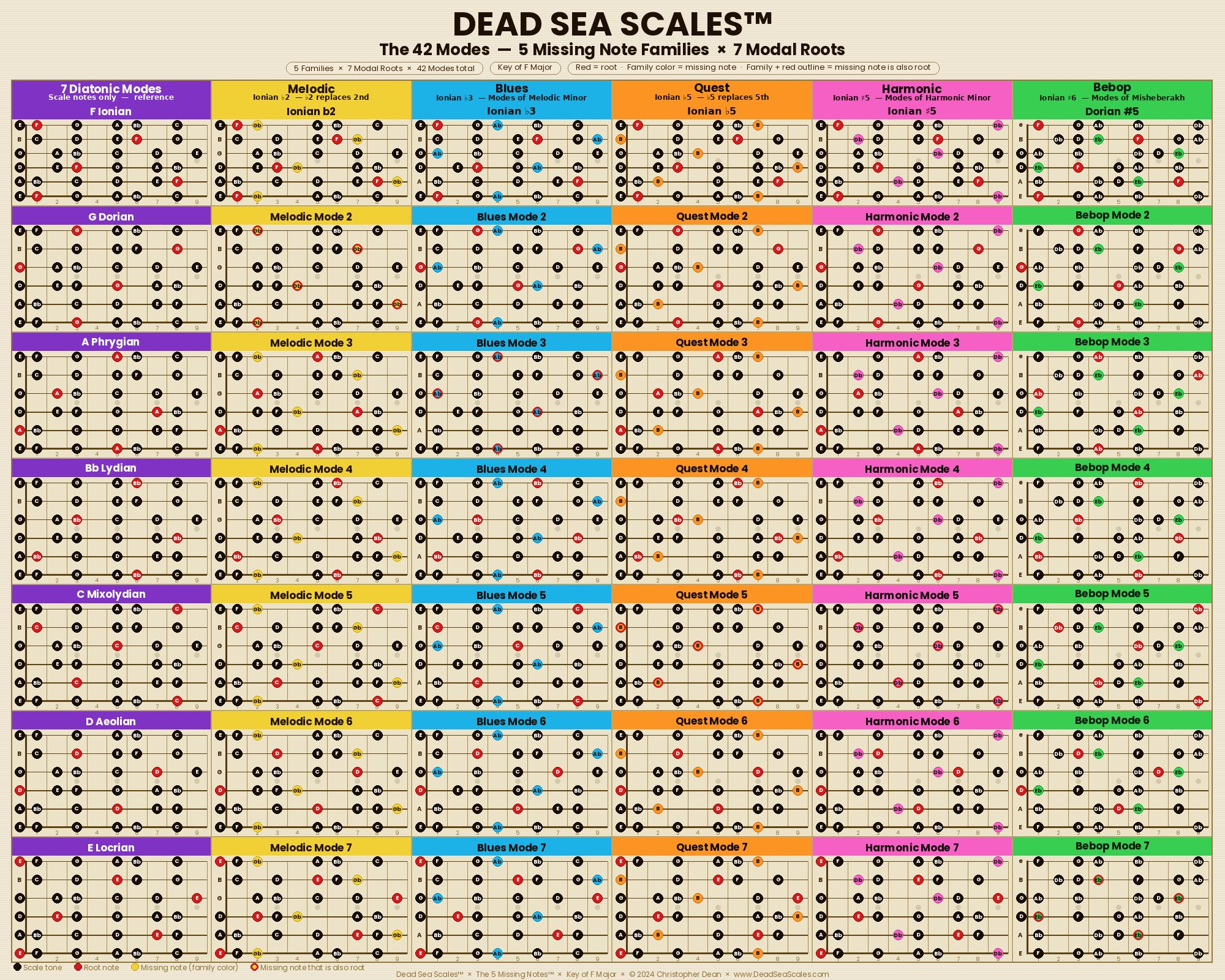
← swipe to explore · red fill = root · family colour + red outline = chromatic as root →
Else World Scales
The mirror system to the 42 Modes — applying the opposite operation to each of the 5 missing chromatic notes.
Understanding the Else World
The 42 regular modes each alter one diatonic interval using a flat or sharp. The Else World applies the opposite operation to the same chromatic pitch — if the regular family flats a note, the Else World sharps it, and vice versa. The result is 35 additional modes that complete the full 77-mode system.
The 5 Else World families break down as 3 sharps and 2 flats:
Melodic Else — Ionian ♯1 · Regular Melodic flats the 2nd (♭2), so Else sharps the 1st (♯1) — same chromatic note, opposite direction
Blues Else — Ionian ♯2 · Regular Blues flats the 3rd (♭3), so Else sharps the 2nd (♯2) — same chromatic note
Quest Else — Ionian ♯4 · Regular Quest flats the 5th (♭5), so Else sharps the 4th (♯4) — same chromatic note
Harmonic Else — Ionian ♭6 · Regular Harmonic sharps the 5th (♯5), so Else flats the 6th (♭6) — same chromatic note
Bebop Else — Ionian ♭7 · Regular Bebop sharps the 6th (♯6), so Else flats the 7th (♭7) — same chromatic note
Each Else World family produces 7 modes using the same positional naming as the regular system — the Ionian alteration rotates through all 7 diatonic positions (Dorian, Phrygian, Lydian, etc.).
Key insight: The regular mode and its Else World counterpart always target the same chromatic pitch but from opposite diatonic positions. Hang both charts side by side — for any modal root, the difference is one note approached from the other direction.
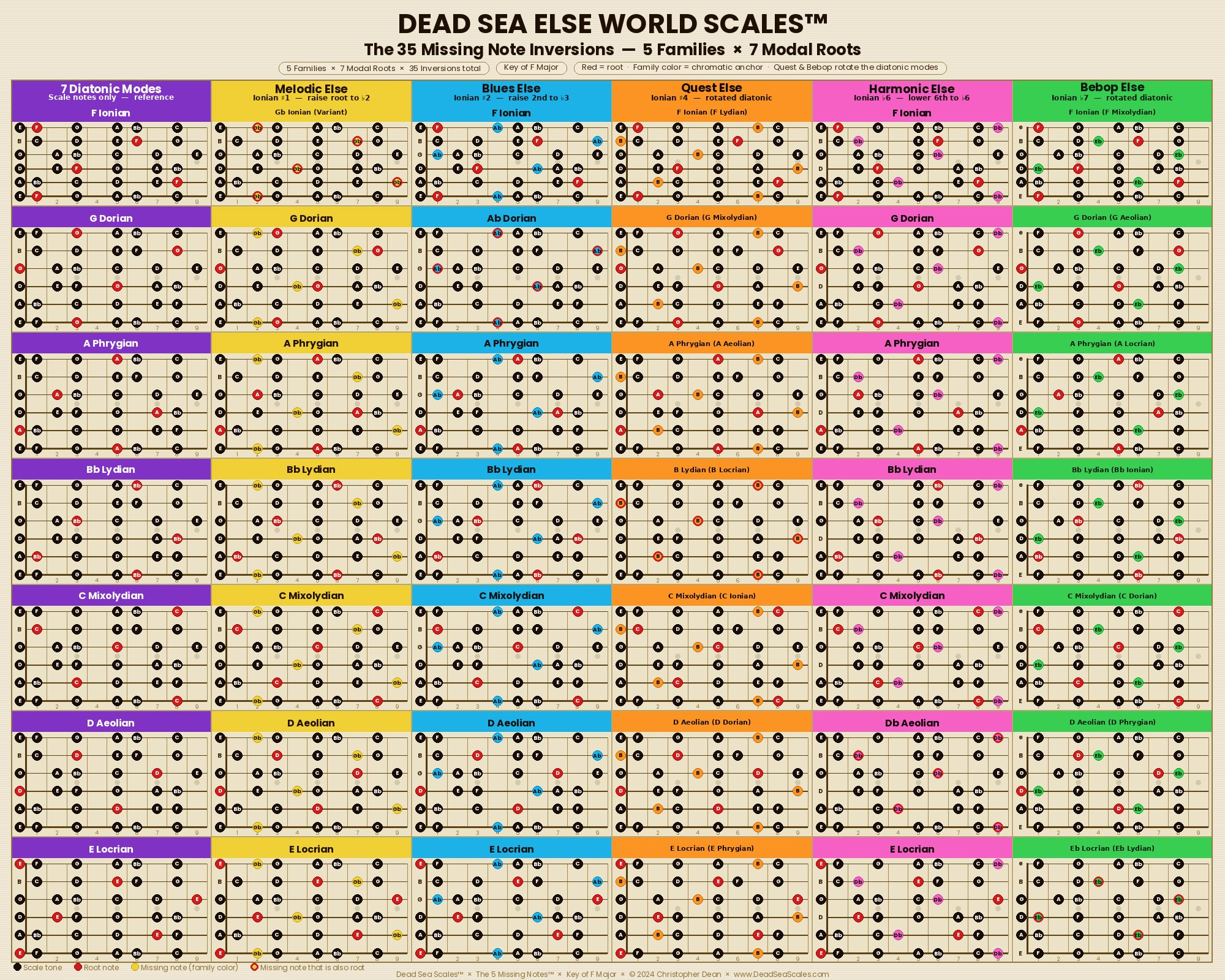
← swipe to explore · red fill = root · family colour = chromatic anchor →
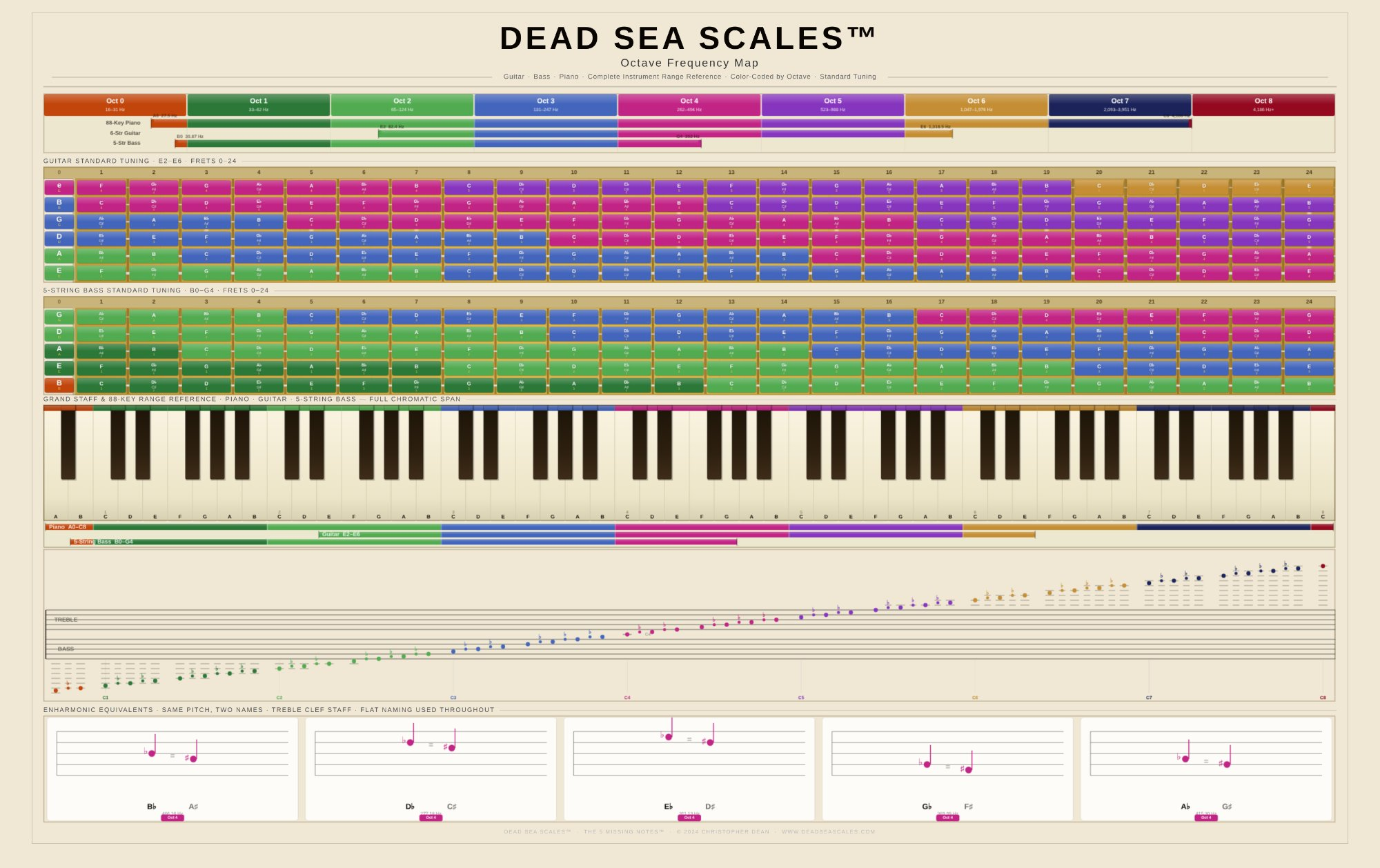
Octave Frequency Map
Guitar · Bass · Piano — every note mapped, color-coded by octave. Click any note to hear it.
① Each color = one octave, shared across all three instruments so you can trace the same pitch everywhere
② Click any note on the fretboard or piano to hear its pitch and see it highlighted across all instruments
③ Guitar sits in octaves 2–6 (E2–E6) · Bass in octaves 0–4 (B0–G4) · Piano spans all 7¼ octaves (A0–C8)
← scroll to explore →
← scroll to explore →
← scroll to explore all 88 keys →
Quick Reference Flashcard
Tap through all the terms · auto-plays every 5 seconds
Terms to Know
Foundational vocabulary for Dead Sea Scales™ — read once, reference forever.
What is Dead Sea Scales™?
What are the 5 Missing Notes™?
What is Music Theory?
What is a Note / Tone?
The Musical Alphabet
Whole Step & Half Step
Four Ways to Discuss a Note's Location
- By the letter name (e.g. A, C)
- By the scale degree / interval name (e.g. minor 2nd, Major 3rd)
- By fretboard location (e.g. 5th fret on the A string)
- By movement in whole steps (W) or half steps (H) from the current note
What is Tuning? What is A440?
What is Pitch?
What is a Chord?
What is a Triad?
What is a Power Chord?
What is Rhythm?
What is Timing?
What is a Melody?
What is Harmony?
What is an Interval?
What is Solfège?
What is a Scale?
What is a Mode?
What is Diatonic, Hexatonic, Pentatonic?
These terms are just some examples of how everything in music theory has more than one name. The “Musicians Code” has confused us all for way too long — and that's what Dead Sea Scales is for. You don't need to spend the next 30 years on a mountain top in Tibet, or meet Robert Johnson at the Crossroads just to find the "missing note." Follow the system step by step to unlock every note. The modes are just a framework for expression — it's the notes in-between that we feel.
Where Did the Notes Come From?
The Greeks' math had a flaw called the Pythagorean comma (~23.45 cents off-tune), which produced the "Wolf Interval" — a howling dissonance. With the addition of the black keys in the 14th century (first chromatic keyboard: Halberstadt organ, 1361), a new system was needed. Vincenzo Galilei (Galileo's father) famously proposed equal temperament in 1581 — slightly nudging each interval so all keys sound equally in tune. Pythagorean temperament sounds purer but is limited in range; equal temperament allows versatility across all keys. When a guitarist bends a note to that sweet spot, they may be tapping back into those original Pythagorean ratios.
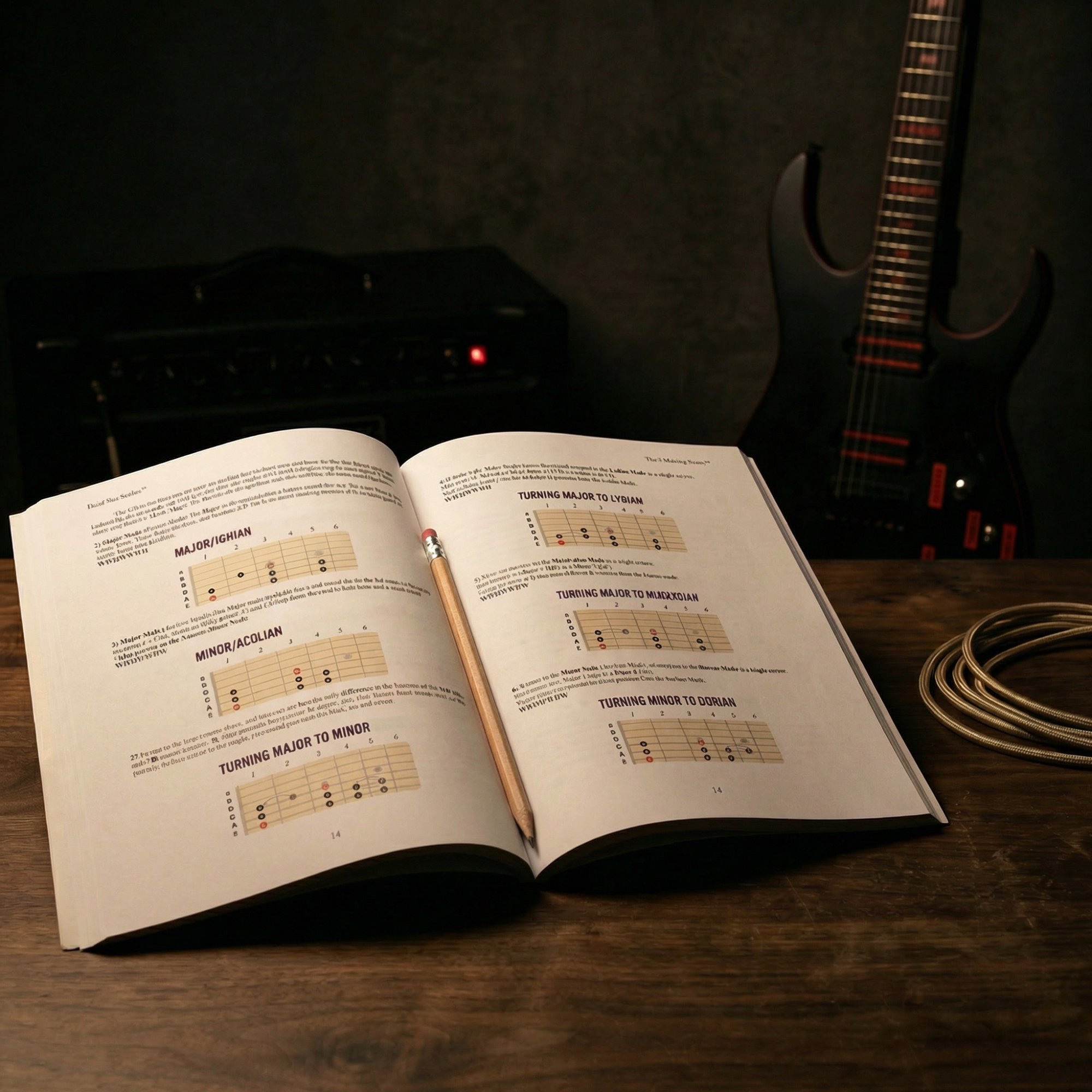
Books, Digital Editions & Print Posters
The complete Dead Sea Scales™ system — paperback, Kindle, and high-resolution print posters. Ships worldwide.
Online Guitar Lessons with Dean via Zoom
Each package includes a digital copy of the book, all 4 PDF posters, and one-on-one attention reinforced with the lesson tools at DeadSeaScales.com.
Dead Sea Scales™ Poster Shop — Now Live
All 4 reference posters available now as premium rolled prints — ready to frame and hang in your practice space, studio, or classroom. Ships worldwide.